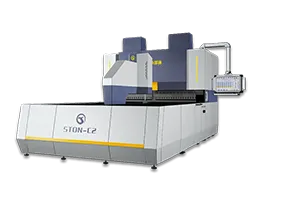
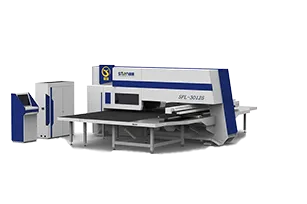
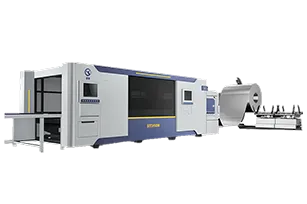
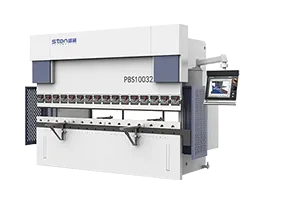
Somos responsables de la construcción-----somos responsables de la fabricación-----somos responsables de la formación

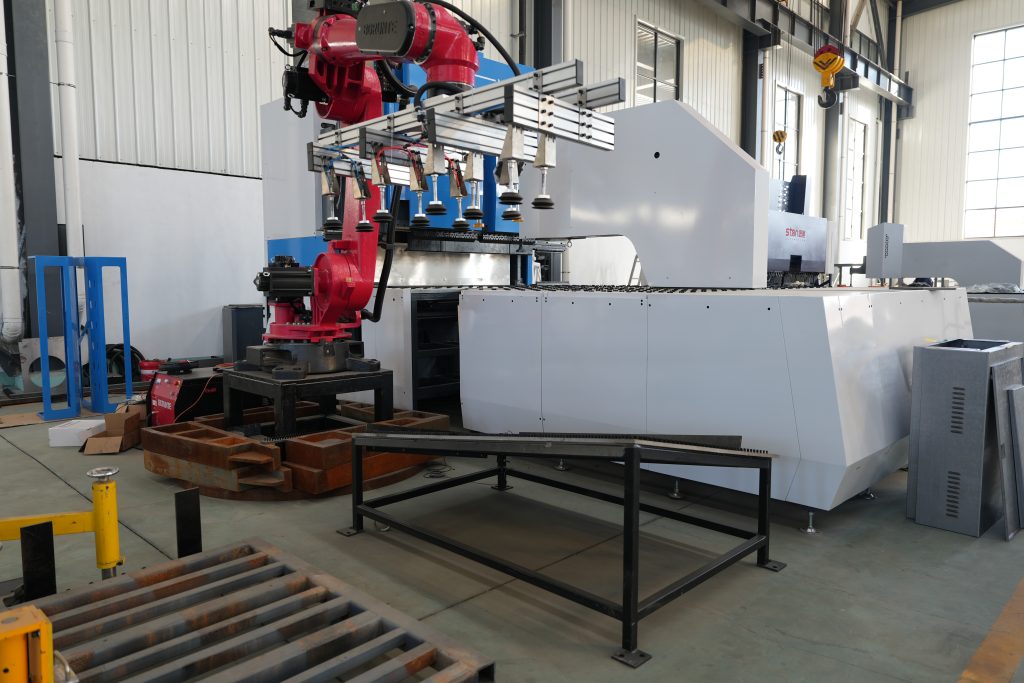
A CNC loading and unloading robot system moves blanks and finished panels between a stack and a forming machine without an operator lifting them. Three types dominate sheet metal work: articulated robotic arms, gantry loaders, and truss-type manipulators. Choose by panel size, floor space, and surface finish risk, not by robot brand.
Afor sheet metal is a handling device plus its end effector, its stack or destack station, its safety enclosure, and the software handshake with the processing machine. The handling device is only one line item of four. Buyers who compare quotations on robot payload alone usually find the price difference sitting in the other three.
Three mechanical architectures are in common use:
Articulated robotic arm. A multi-joint arm mounted on a floor pedestal or a short linear track, reaching into the machine from the side or the front. Motion is free-form, so one arm can serve a bender, a stacking pallet, and a rework table from the same base.
Gantry loader. A bridge structure spanning the machine, with a vertical Z-axis carrying the pick head. Motion is Cartesian: X, Y, Z, sometimes a rotation. It works above the machine rather than beside it.
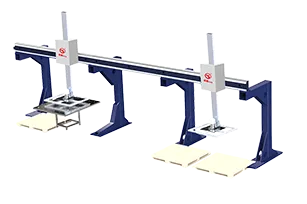
Truss-type manipulator. A rail-mounted carriage running along an overhead beam, usually spanning several metres and serving one or more machines in a line. Structurally it is a stretched gantry, and in practice suppliers use the two words interchangeably. The distinction that matters is span: a gantry is usually built around a single machine envelope, a truss runs down a process line.
STON supplies robotic-arm and truss configurations as standard product lines, and the panel bender and flanging platforms retain a native docking interface that accepts robotic arms and gantry loaders from most manufacturers on the market. That interface point is worth checking on any machine you already own, because retrofitting one is an order of magnitude more expensive than specifying it.

| Selection Dimension | Articulated Robotic Arm | Gantry Loader | Truss Manipulator |
|---|---|---|---|
| Floor Space Added | Pedestal footprint plus swept safety envelope beside the machine | Minimal added floor area; occupies the volume above the machine | Rail length runs the whole cell; supports land at fixed pier points |
| Ceiling Height Needed | Low | Moderate to high | High, plus a clear overhead run |
| Panel Size Handled | Limited by reach and by moment arm at full extension | Set by beam span and head design | Longest panels of the three, set by rail length |
| Motion Type | Free-form, multi-position | Linear, repeatable | Linear along a line of machines |
| Serves Multiple Machines | Two, sometimes three within one reach circle | Normally one | Several in sequence |
| Changeover Flexibility | Highest; new part path is a program change | Medium; may need head or fixture change | Medium |
| Surface Damage Exposure | Gripper contact points and swing clearance | Suction pick, mostly vertical motion | Suction pick over long transfers |
| Typical Fit | Mixed-model work, short runs, awkward part shapes | Single high-volume machine, tight floor plan | Cutting-to-bending line, long panels |
| Main Weakness | Reach circle is fixed once the pedestal is anchored | Rebuilding the cell layout later is costly | Long un |
Most published comparisons of CNC handling automation come from the machine-tool-tending world, where the part is a chuck-sized billet and the deciding factor is payload. Sheet metal inverts that. A 1.0 mm cold-rolled blank at 1200 × 650 mm weighs about 6 kg but has an area of 0.78 m² and almost no bending stiffness. The problems are flatness during transfer, double-sheet pickup, and surface marking, not lifting force. Read payload-led comparisons with that in mind.
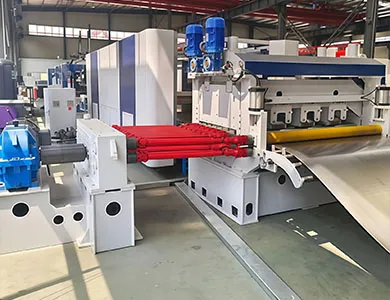
The number that ruins layouts is not the robot’s own footprint. It is the fenced area around it.
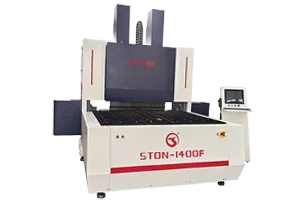
STON panel benders in the press-arm series give an indication of the base machine envelope: the A (1000) welded model measures 425 × 160 × 255 cm, and the B (1400) cast-bed model 450 × 206 × 290 cm. Those are machine dimensions with no handling equipment attached.
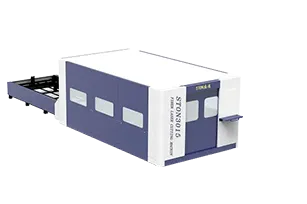
A comparable jump shows up in the laser cutting range, where the same 3015 format is offered in single-table and exchange-table builds. The single-table machine occupies roughly 4500 × 2600 mm. The exchange-table version occupies roughly 9000 × 3100 mm. Same cutting area, 2.4 times the floor space, because material handling has been designed into the machine rather than bolted beside it.
Apply the same arithmetic to your own cell:
This is the section most equipment pages leave out, and it changes purchasing decisions more than any throughput claim.
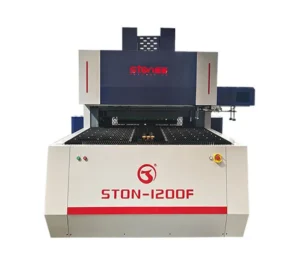
Adding automatic loading and unloading to a forming machine reduces the largest part the machine can produce. The gripper or suction head needs clearance inside the forming area, and the transfer path needs room that the manual operator did not need. STON’s flexible edge bending (flanging) machines publish both figures, which makes the effect measurable:
| Modelo | Max Forming Dimension, Manual (mm) | Max Forming Inner Dimension with Automatic Loading/Unloading (mm) | Reduction in the Second Dimension |
|---|---|---|---|
| 1200 | 1200 × 1200 | 1200 × 650 | −46% |
| 1600 | 1600 × 1250 | 1600 × 950 | −24% |
| 2000 | 2000 × 1500 | 2000 × 800 | −47% |
Across all three models the length axis is unaffected and the width axis carries the whole loss. Minimum four-sided inner dimension stays at 200 × 200 mm and minimum bending height at 4 mm in both configurations, so the small-part end of the range is unchanged.
Two consequences follow. First, if your largest running panel is close to the manual limit, automation may simply exclude that part number, and you will be running it manually on the same machine anyway. Second, the reduction is not proportional across the range, so a model that looks like the obvious size step up may give you less automated width than the model below it. Take your five highest-volume panel sizes, lay them against the automated column rather than the headline column, and check the fit before choosing a machine size.
A common misconception is that this limit is a software setting that can be relaxed after installation. It is mechanical. The clearance belongs to the pick head and the transfer path, and changing it means changing hardware.
Scratched panels are the most frequent complaint after an automation retrofit in cabinet, kitchen equipment, and appliance-panel plants, where the material arrives pre-galvanised or as stainless with a protective film. Three mechanisms account for most of it.
Contact during pickup. STON flanging machines use a patented suction-cup feeding method with 360° free rotation, which spreads the holding load over the pad area instead of concentrating it at gripper jaws. Suction is generally kinder to a finished face than mechanical clamping, but it demands a flat, clean, dry blank; oil residue or a curled leading edge causes drop events, and a dropped panel is a scrapped panel.
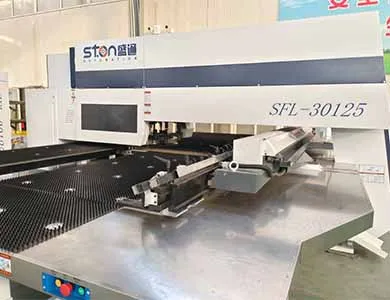
Sliding contact on the machine table. The turret punch press platform uses a brush and omnidirectional steel-ball composite tabletop, customisable to pure bristle brush or pure steel ball, with a stainless steel edged countertop. That choice is not cosmetic. Steel balls roll well under heavier sheets but can leave point marks on soft or coated material; full brush is gentler and slower. Specify the tabletop against your worst-case surface requirement, not your average one.
Stacking at the unload end. Panels stacked without spacing rub against each other under their own weight during pallet transport. Interleaving or programmed spacing at the stacking station is an option on most systems and is cheap to add at order stage.
Where the surface specification is critical, ask for a sample run with your own material and your own protective film before signing off. Film behaviour under suction varies by supplier and by ambient temperature, and no specification sheet will tell you how yours performs.
| Artículo | STON Published Requirement | Por qué es importante |
|---|---|---|
| Machine Handling Interface | Native docking port on panel bender and flanging platforms; accepts most robotic arm and gantry brands | Determines whether integration is configuration or custom engineering |
| Air Supply | 0.6 MPa at panel benders; 0.55 MPa at turret punch presses; 0.5–0.6 MPa and 0.6 m³/min on production lines | Suction pickup fails intermittently on marginal air, and intermittent faults are the hardest to diagnose |
| Fuente de alimentación | Three-phase 380 V ±5% at machine level; 3φ 400 V ±5%, 50 Hz ±2% quoted for line configurations | Affects transformer sizing at the cell |
| Machine Table Load | 150 kg maximum load capacity on the turret punch press table | Caps stack weight staged on the machine |
| Guarding | Protective covers on protruding parts; fully enclosed rear enclosure on flanging machines | Baseline for the risk assessment, not a substitute for it |
For equipment entering the EU, the handling cell is assessed as an assembly of machinery. Risk assessment follows EN ISO 12100, safety-related control functions are rated to EN ISO 13849-1, and press-type forming equipment in the cell falls under EN 12622 or EN ISO 16092 depending on the machine. Compliance is against Machinery Directive 2006/42/EC, transitioning to Regulation (EU) 2023/1230. Confirm at order stage who carries responsibility for the conformity assessment of the combined cell: the machine builder, the integrator, or you. On retrofits to an existing machine, it is frequently the end user, and that surprise arrives late.
A: An unloading robot is a programmable arm with free-form motion. An unloading machine usually means a mechanical device with fixed or linear motion, such as a gantry loader, truss manipulator, or stacker. The robot is programmed for a new part; the machine is often reconfigured for one.
A: If the machine has a native handling docking port, yes, and the work is mostly configuration. STON panel benders and flanging machines retain that interface as standard. Without one, expect custom mechanical and control engineering that can cost as much as the handling unit.
A: STON does not publish list prices for handling systems, because the figure depends on the handling type, the end effector, the number of stack stations, the guarding, and the machine it integrates with. Request a quotation with your panel dimensions, material, thickness, stack height, and target takt time, and ask for the layout drawing alongside the price so you can verify the footprint.
A: Not necessarily. On the flanging machines the automated forming envelope is narrower than the manual one, by 24% to 47% on the width axis depending on model. Check your largest panel against the automated figure specifically.
A: An articulated arm, in most cases, because reprogramming a path is cheaper than changing a pick head. Once panels pass about 2 m, the calculation moves toward a gantry or truss even with a mixed product range.
A: STON provides training through video tutorials, manuals, and on-site sessions, with 24/7 technical support and a 48-hour on-site response commitment. Plan for the sequence programming to be the part your team needs longest, not the daily operation.
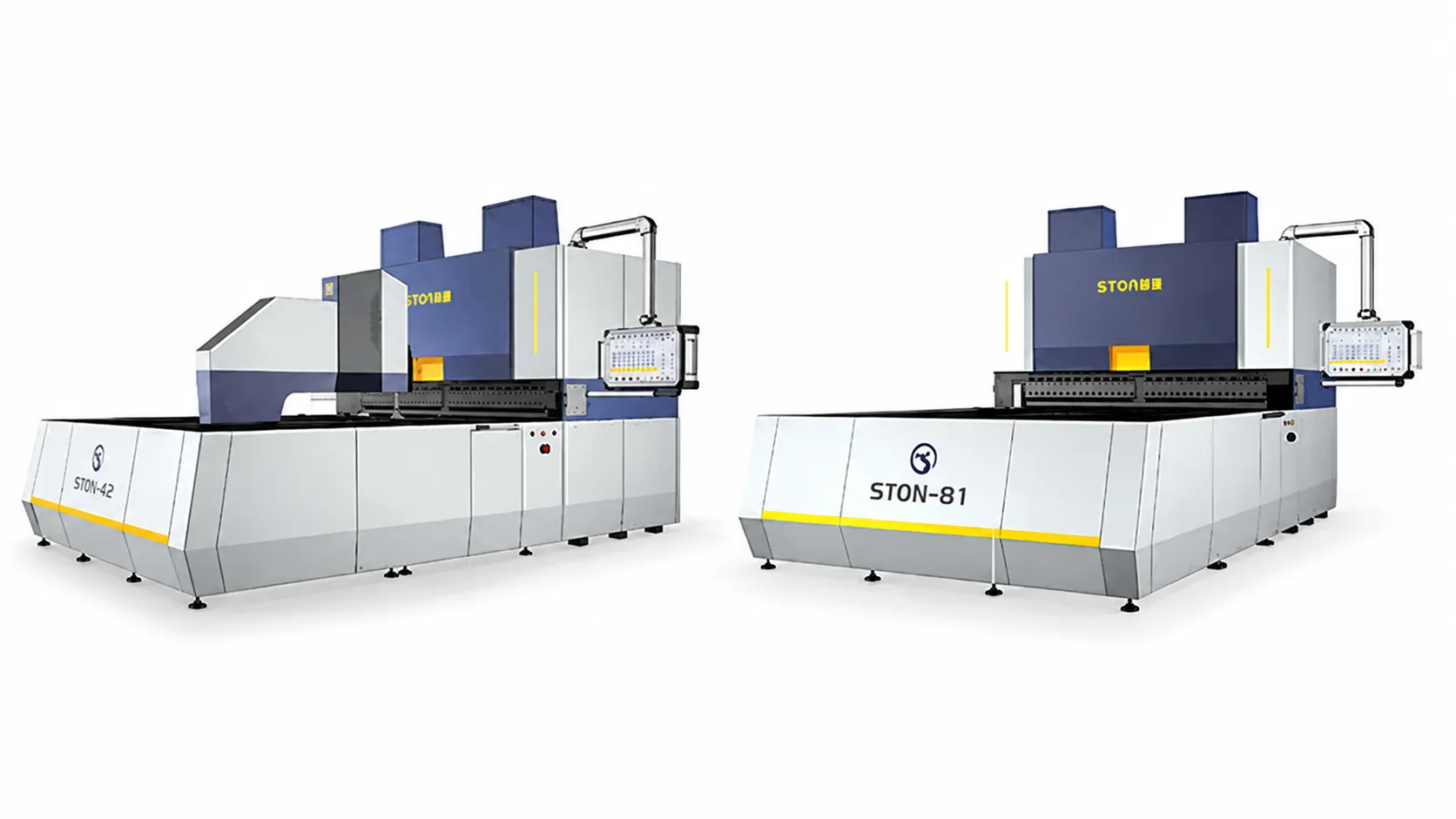
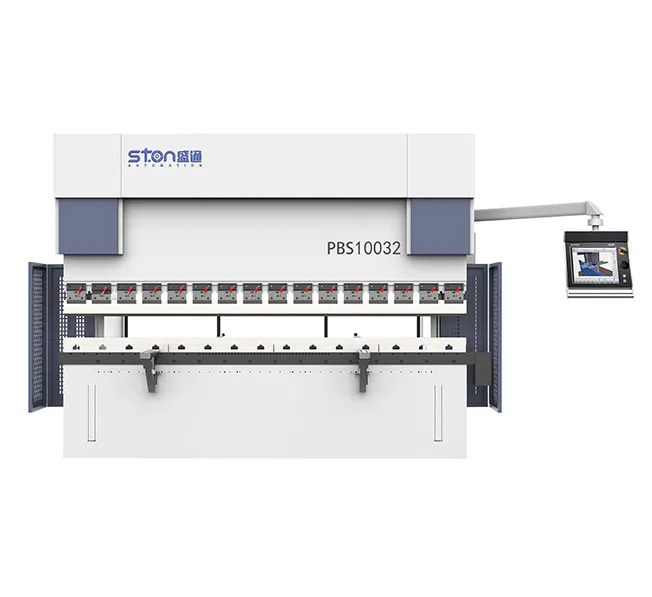
Tanto si está actualizando una línea existente como si está iniciando un nuevo proyecto, STON personalizará una solución CNC para su producción.